The "Superapp" is the biggest lie in crypto.
Coinbase is betting its future on becoming WeChat. They are wrong.
They are ignoring a fundamental law of human psychology: You cannot bundle a casino with a bank vault.
Here is why the Superapp is dead, and why the future belongs to constellations.
Every cycle, the pitch is the same. Whether it is a seed-stage founder or @coinbase, the finger points to @Weixin_WeChat. The promise is the "Everything App"—chat, trading, NFTs, and payments, all in one dashboard.
It seduces investors hungry for infinite TAM.
But the reality is a graveyard.
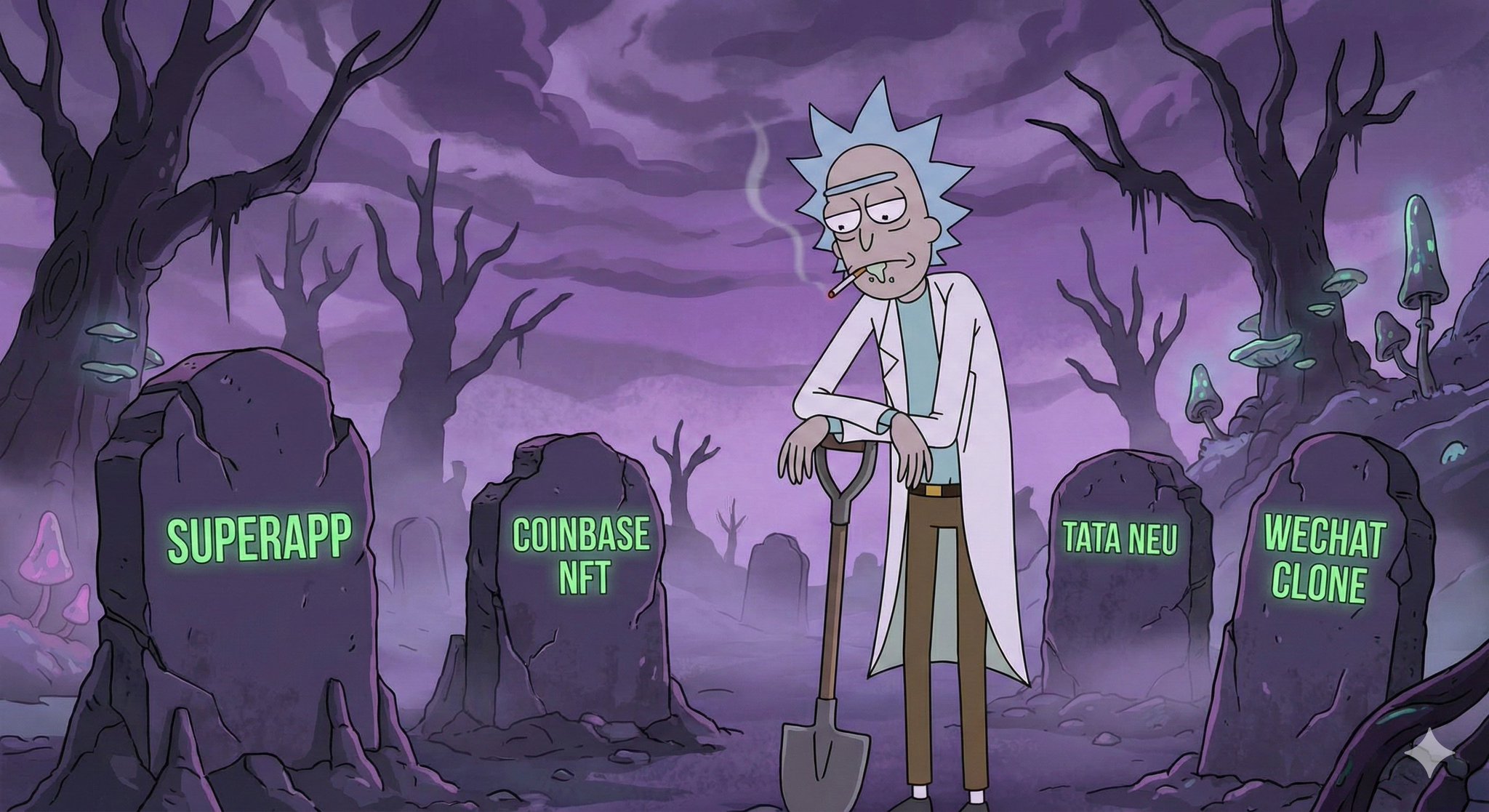
Coinbase is stumbling because it violates a distinct psychological law:
You cannot bundle Social Discovery with Financial Sovereignty.
The Superapp is dead on arrival. The future belongs to Segmented Constellations.
1. The Coinbase Identity Crisis
The history of Coinbase is a masterclass in product panic.
Exhibit A: Coinbase NFT.
They didn't just build a marketplace; they attempted to force a social network onto a financial engine. Comments, profiles, and feeds. The thesis was that people want to socialize where they transact.
The market rejected it.
Why? Because Trader Mode is solitary. When money is on the line, users demand liquidity, speed, and execution—not chat windows.
Yet, they refused to learn.
In 2025, the Base App (founder @jessepollak) doubled down. They rebranded as a "social + trading" platform, prioritizing Creator Coins and "For You" feeds over core infrastructure. The result was a user revolt against the app's "Web2 feel," forcing a humiliating pivot back to a trading-first interface.
This is not iteration. It is confusion.
Coinbase is trying to jam Passive Consumption (scrolling) into Active Management (signing).
When you mix a dopamine loop with a bank vault, you don't get a Superapp. You get an app that feels bloated, unfocused, and dangerous.
2. The Psychology: Why Your Brain Hates Superapps
The barrier isn’t code. It is biology.
According to Cognitive Load Theory, the human brain operates on a strict energy budget. As Daniel Kahneman famously outlined, we have two distinct operating modes:
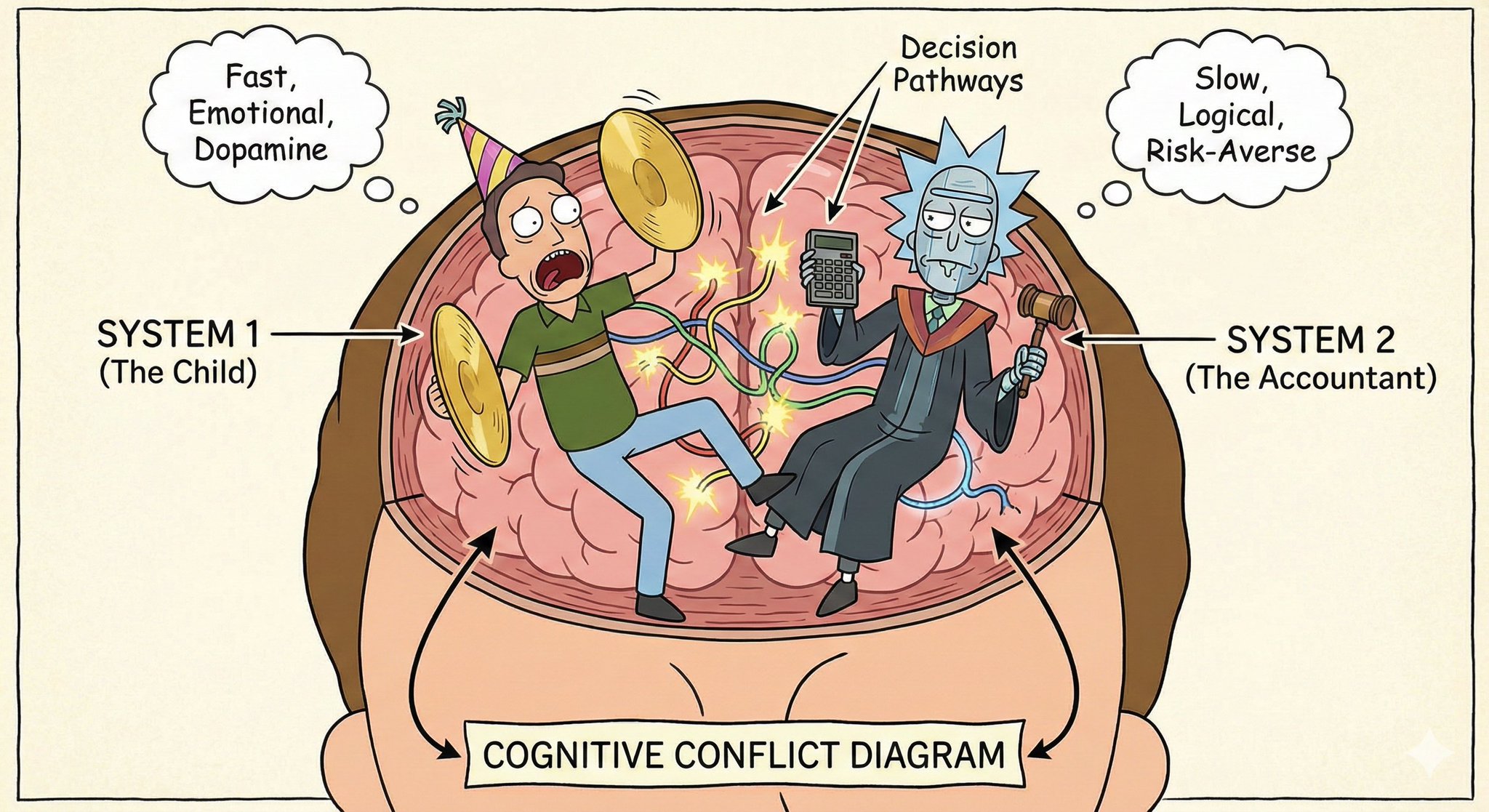
- System 1 (The Child): Fast, intuitive, dopamine-seeking. (e.g., Scrolling TikTok, liking a tweet).
- System 2 (The Accountant): Slow, effortful, risk-averse. (e.g., Verifying a contract address, calculating gas fees).
The Web3 Superapp fails because it forces these two systems into a cage match.
When Coinbase places a "Trending Memecoins" feed (System 1) next to a "Bridge Assets" interface (System 2), it triggers the Split Attention Effect.
You are trying to execute a high-stakes financial transaction while the UI is screaming at you to look at a monkey picture. It is like trying to perform brain surgery in the middle of a nightclub.
The result is Cognitive Debt.
Your brain cannot switch gears fast enough. Decision fatigue sets in. You miss a decimal point. You sign the wrong permission. You get rekt.
Silicon Valley solved this paradox a decade ago.
Look at Google.
They have the resources to build the ultimate Superapp. One icon. One feed. One surface. Technically, it is trivial. Gmail, Drive, and Docs already share the same infrastructure.
Yet, they choose to unbundle.
On your phone, these are separate apps. Why? Because Google understands what Coinbase ignores: Mental Posture.
Google does not force you to draft a legal contract inside your spam folder, nor do they bury your meeting reminders inside a code editor. They refuse to collapse creation, coordination, and review into a single, infinite scroll.
Segmentation protects focus.
Coinbase does the opposite. They collapse incompatible mental states—discovery, speculation, and execution—into one chaotic dashboard. Then they wonder why their users feel anxious, distracted, and prone to error.
The brain isn’t resisting innovation. It is enforcing boundaries.
3. The Indian Lesson: Zomato vs. Blinkit
Forget WeChat. The blueprint for Web3 lies in India.
Consider the battle between two strategies.
On one side, you had Tata Neu. The massive conglomerate poured over $2 billion into a single Superapp, bundling electronics, groceries, and flights. It was sluggish, confusing, and a massive flop.
On the other side, you have Zomato (founder @deepigoyal).
When the food delivery giant acquired Blinkit (quick commerce, founder @albinder), they faced a choice. They shared the same users, the same wallets, and the same investors. The standard "VC Logic" dictated a merger.
Zomato refused. They kept the apps separate.
Why? Because they understood that Time Frame dictates Architecture.
- Zomato is "Dinner Mode" (Deliberate). You are hungry, but you are patient. You scroll through menus. You debate Chinese vs. Italian. You check reviews. It is a 20-minute ritual of anticipation.
- Blinkit is "Panic Mode" (Urgent). You are out of milk. You need diapers. You have guests coming in 15 minutes. You do not want to browse; you want to hunt, click, and receive.
If Zomato had merged them, the UI would have collapsed. The user needing emergency batteries (Blinkit) would be slowed down by "Recommended Dishes" (Zomato).
Web3 is making the Tata Neu mistake.
- Dexscreener is Zomato. It is for the deliberate hunt. You scan charts. You filter by volume. You analyze the holders to find the next gem. It is a slow, analytical state.
- Uniswap is Blinkit. It is for the urgent execution. You have the contract address. You check the slippage. You hit swap. It is a fast, transactional state.
This is the design philosophy behind what I’m building with @brightside_gg: a perps-only app that refuses to dilute execution with discovery or social noise.
Coinbase is trying to bundle these opposing time frames into one "Superapp."
The result is an app that cannot decide what you are here for.
It forces you to browse when you need to act, and act when you need to think. And under stress, users do not adapt.
They leave.
4. The "Walled Garden" is Obsolete
To understand why the Superapp is dying, you must understand why it lived.
WeChat did not win because it had better features. It won because it held your data hostage. You could not take your chat history to Telegram. You could not move your reputation to WhatsApp.
Web2 Moats are built on captivity.
Web3 architecture destroys this captivity. It introduces the ultimate weapon: Wallet Portability.
In crypto, the application does not own the user. The user owns the user.
- Your Identity: Not a row in Coinbase’s database. It is your ENS.
- Your Assets: Not stuck in a bank silo. They are on the ledger.
- Your History: Not locked in a proprietary server. It is on-chain.
You are not a resident anymore. You are a traveler. Every app is just a rented room. You unpack, you stay as long as the service is good, and you leave with all your luggage the moment it isn't.
If you doubt this shifts power, look at India’s payment revolution.
Before UPI, India had "Superapp Wallets" like Paytm. You loaded money into the wallet. If your friend used a different wallet, you were stuck. The money was trapped behind a garden wall.
Then UPI launched. It was an open protocol that let money move freely between banks.
Overnight, the "Walled Garden" model collapsed.
- You didn't need to store money in the app.
- You could switch from Google Pay to PhonePe in seconds without losing a rupee.
- The apps became interchangeable skins on top of a public utility.
This is the nightmare scenario for Coinbase.
They are trying to build a Walled Garden (The Superapp) on top of an infrastructure designed to destroy walls (The Blockchain).
In a world where the exit door is always open, users have zero tolerance for bad products.
If Coinbase’s swap fee is 0.5% too high, you do not suffer through it. You do not lose your login. You do not lose your friends.
You simply disconnect your wallet, close the tab, and open 1inch.
Web2 was about building a Trap. Web3 is about building a Magnet.
5. The Future: Constellations, Not Monoliths
The winners of the next cycle won't be the Generalists. They will be the Specialists.
Coinbase is making the AOL mistake.
Why is Coinbase trying to jam social feeds, prediction markets, and perps into a single app?
It isn't because the user asked for it. It is because they want to capture the value.
They want your attention (Time). They want your distribution (Eyeballs). Most of all, they want your fees (Money).
The Superapp is a trap designed for extraction, not utility.
This is exactly what AOL tried to do in the 90s. For younger readers: AOL was the dominant internet gateway of the 1990s, reaching over 30 million users at its peak, and functioned as a closed “everything app” for email, chat, news, and content.
AOL didn't bundle News, Chat, and Weather because it was a better experience. They bundled it because they wanted to own 100% of your time online. They wanted to be the Hub.
But the "Capture Strategy" always fails against the "Product Strategy."
- AOL wanted to own "Search" to sell ads. Google just built a better search engine.
- AOL wanted to own "Chat" to keep you logged in. Facebook just built a better social network.
AOL lost because they were optimized for Business Capture.
The Specialists won because they were optimized for User Outcome.
The same war is playing out in Web3.
The "Monoliths" (Coinbase, Binance) are trying to build walls to keep the value inside. The "Constellation" is tearing those walls down.
- The Hub: Your Wallet (Identity).
- The Stars: Hyper-specialized protocols (Uniswap for execution, Polymarket for speculation, even mobile apps).
- The Gravity: Intents that bridge them instantly.
Users will always choose the Specialist. They don't care about your "Value Capture." They care about their "Execution."
To the Builders:
Stop chasing the ghost of WeChat. WeChat is a regulatory anomaly, not a product roadmap.
Stop adding social feeds to your trading terminals. Stop jamming swap widgets into your chat apps.
Be the Blinkit of DeFi. (Master Speed). Be the Zomato of NFTs. (Master Discovery).
Focus on one intent. Master it.
In an economy of fractured attention, Clarity is the only alpha.
3 Key Takeaways
- Biology Rejects the Bundle: The brain cannot multitask between System 1 (Dopamine/Social) and System 2 (Calculus/Finance). Mixing them isn't innovation; it's a biological conflict that causes cognitive debt and user churn.
- The Trap of Extraction: The Superapp is a business model designed to capture value (fees/attention), not a product designed to help users. As history shows (AOL vs. Google), strategies optimized for "Business Capture" always lose to Specialists optimized for "User Outcome."
- The "Zomato" Rule: Intent dictates architecture. You cannot merge Discovery (Slow/Leisure) with Execution (Fast/Panic). Successful Web3 products will be Constellations of specialized tools, not monolithic traps.
A huge shoutout to @yashjhade, @bhajipav & @yash_chandak for reading drafts and pushing this idea forward.